


And Among His Signs Are the Ships in the Sea, Like Mountains


And Among His Signs Are the Ships in the Sea, Like Mountains
The Qur’an — Surah Ash-Shura 42:32–33
وَمِنْ آيَاتِهِ الْجَوَارِ فِي الْبَحْرِ كَالْأَعْلَامِ
إِن يَشَأْ يُسْكِنِ الرِّيحَ فَيَظْلَلْنَ رَوَاكِدَ عَلَىٰ ظَهْرِهِ ۚ إِنَّ فِي ذَٰلِكَ لَآيَاتٍ لِّكُلِّ صَبَّارٍ شَكُورٍ
English:
“And among His signs are the ships in the sea, like mountains. If He wills, He can still the wind, leaving them motionless on its surface. Surely in this are signs for everyone who is steadfast and grateful.”
I recently heard someone discuss these verses mockingly. His argument was essentially: How can this be a sign of Allah? Today we do not need the wind—we simply put an engine in the ship and it moves.
But before accepting that argument, there is a simple scientific question we should ask:
What exactly is wind?
Wind is moving air.
The Qur’anic word الرِّيح (ar-rīḥ) here means the wind. It does not mean that the atmosphere or oxygen disappears. But physically, wind cannot exist without air:
No air → no wind.
Air that is still → air, but no wind.
Air in motion → wind.
Fourteen centuries ago, a sailing ship used moving air directly. Wind flowed across its sails, producing the force that drove the vessel through the water.
Modern ships changed the technology. Instead of catching moving air with enormous sails, they can use enormous diesel engines turning propellers.
But here is where the question becomes fascinating.
Did the Modern Engine Really Make Air Unnecessary?
Consider one of the largest marine diesel engines ever constructed: the 14-cylinder Wärtsilä RT-flex96C.
At full power, this enormous engine produces about 80 megawatts. It cannot produce that power from fuel alone. Combustion requires oxygen, and that oxygen is obtained from the enormous quantity of atmospheric air drawn through the engine.
So the comparison becomes:
Ancient ship: air moves across the sails → ship moves.
Modern diesel ship: air enters the engine → oxygen supports combustion → engine turns the propeller → ship moves.
These are not the same physical mechanism, and we should not pretend they are. A sail does not consume air, whereas a diesel engine processes air and consumes some of its oxygen.
But both raise an interesting question about air.
Which One Involves More Air?
Using the engine figure we have been examining, the giant marine engine can process on the order of hundreds of tonnes of air every hour at very high power.
Now imagine an ancient sailing vessel making the same journey.
Its sails might have hundreds or even thousands of square metres of sail area, with wind continuously flowing across them for days.
So the question I wanted to investigate was not simply:
“Can an engine replace a sail?”
Of course it can.
The much more interesting question is:
During the same journey, how much air passes through a giant modern marine engine, and how does that compare with the mass of moving air interacting with the sails of an ancient ship?
If a modern engine processes tens of thousands of tonnes of air during a long voyage, while an ancient vessel depended on moving air across its sails, then saying “we don’t need wind because we have an engine” does not mean modern engineering has somehow eliminated air from the equation.
It means we changed the mechanism.
The ancient sailor captured the motion of the atmosphere directly.
The modern engineer takes oxygen from that atmosphere, combines it with fuel inside an enormous combustion engine, and transfers the resulting energy through a propeller into the sea.
Technology changed dramatically. The laws of nature did not.
Part 2 — Just How Big Is the Engine That “Replaced” the Sails?
Then use this short introduction:
We have established an important distinction: an ancient sailing ship used moving air — wind — directly against its sails, while a modern diesel-powered ship uses an engine.
But when someone simply says, “We don’t need the wind anymore; we have an engine,” the word engine can make the solution sound almost simple.
It isn’t.
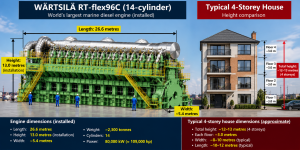
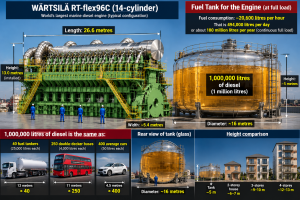
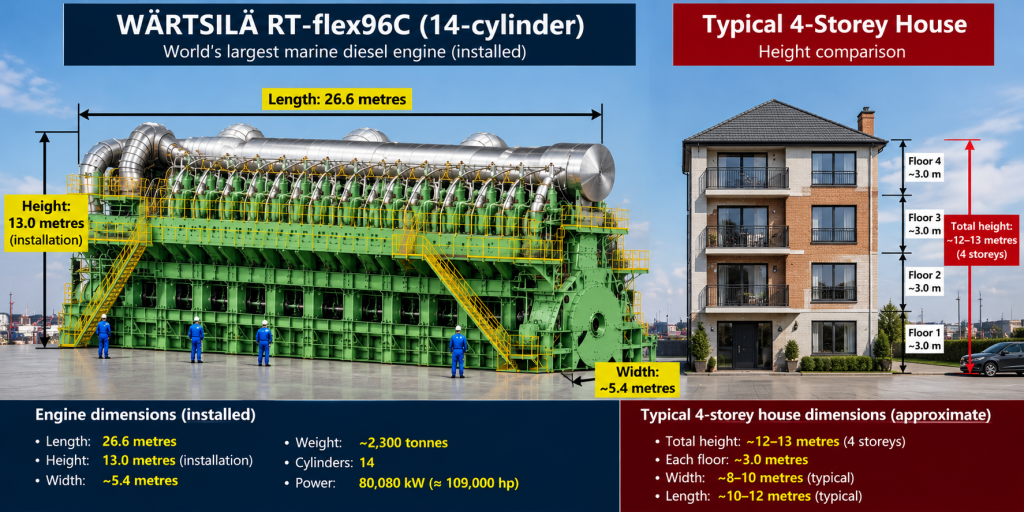
Some modern marine engines are among the largest machines ever installed in ships. To understand the scale, consider the 14-cylinder Wärtsilä RT-flex96C.
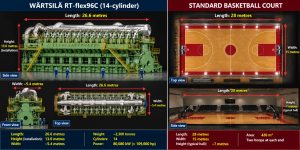
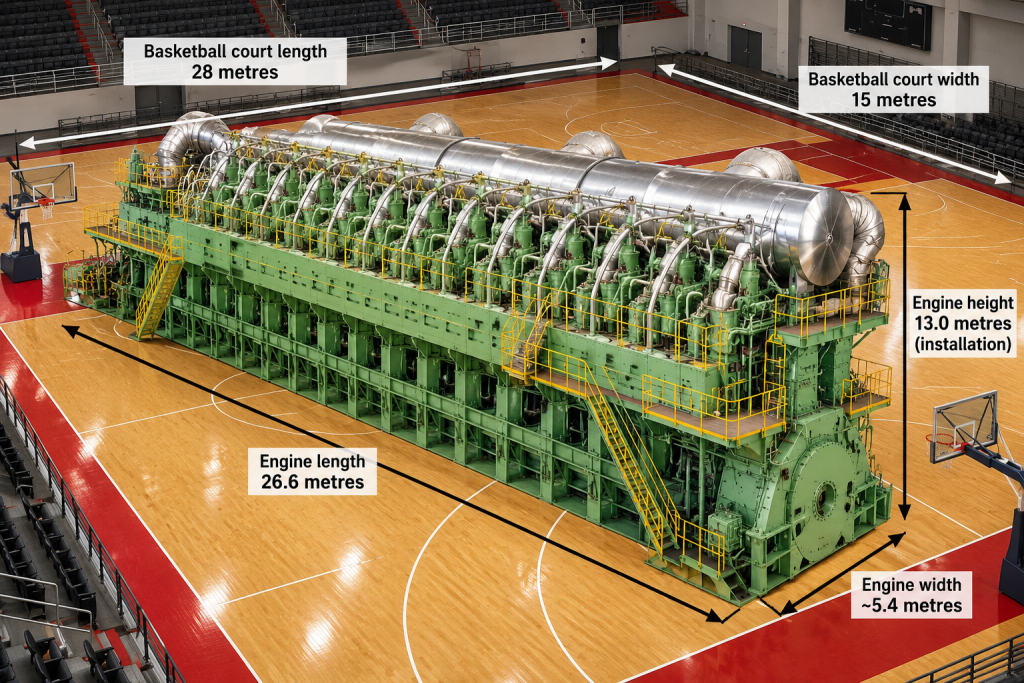
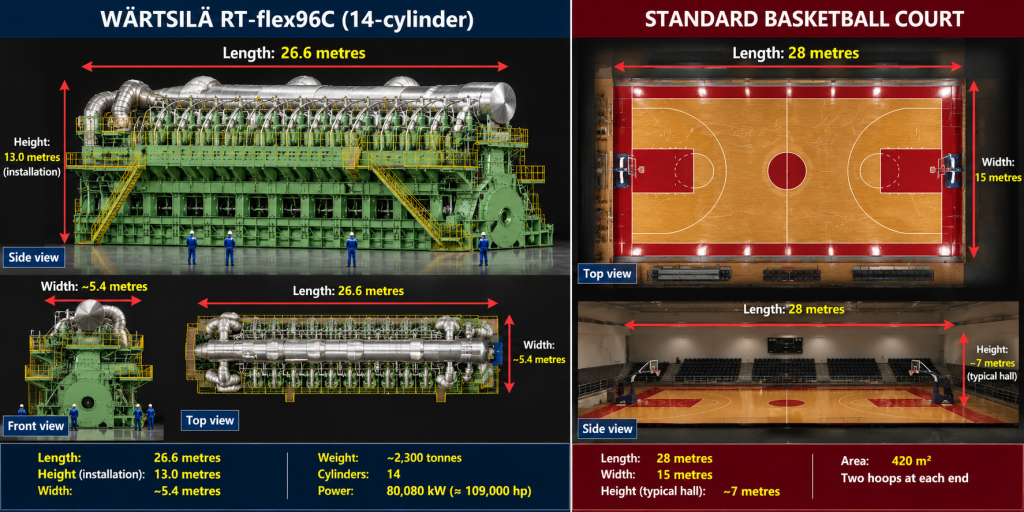
It is roughly 26.6 metres long. A standard FIBA basketball court is only 28 metres long. In other words, this single engine is almost as long as the entire playing court.
Its installation height is around 13 metres — roughly comparable to a four-storey building.
And this enormous machine exists for one purpose: to generate enough power to drive a giant ship through the sea.
But its size is not the most interesting part of our investigation.
The real question is: what does this enormous engine require every second in order to keep running?
Part 3 — The Engine Replaced the Sails, But What Does the Engine Need?
We have now seen just how enormous this engine is. But size alone does not make a ship move.
A diesel engine cannot simply be filled with fuel and expected to run.
It needs something else continuously:
AIR.
More precisely, the engine needs the oxygen contained in the air for combustion.
Inside the cylinders, enormous quantities of air are compressed. Fuel is then injected into the hot compressed air. The fuel burns because oxygen is available, producing expanding gases that force the pistons downward and ultimately turn the ship’s propeller.
Remove the fuel, and the engine stops.
Remove the air — and the engine also stops.
And this brings us back to the original discussion about wind.
Wind and Air Are Connected
Wind is air in motion.
The ancient sailing ship needed moving air outside the ship. That moving air pushed against its sails.
The modern diesel ship does not need wind pushing its sails, but its engine still requires atmospheric air because combustion requires oxygen.
So these are two very different technologies:
Ancient sailing ship:
Moving air → sails → ship moves.
Modern diesel ship:
Air + fuel → combustion → engine → propeller → ship moves.
The engine therefore did not make air irrelevant. It changed the way the ship interacts with air.
Now Look at the Numbers
The 14-cylinder Wärtsilä RT-flex96C can produce 80,080 kW — about 108,920 horsepower — at 102 rpm. Wärtsilä
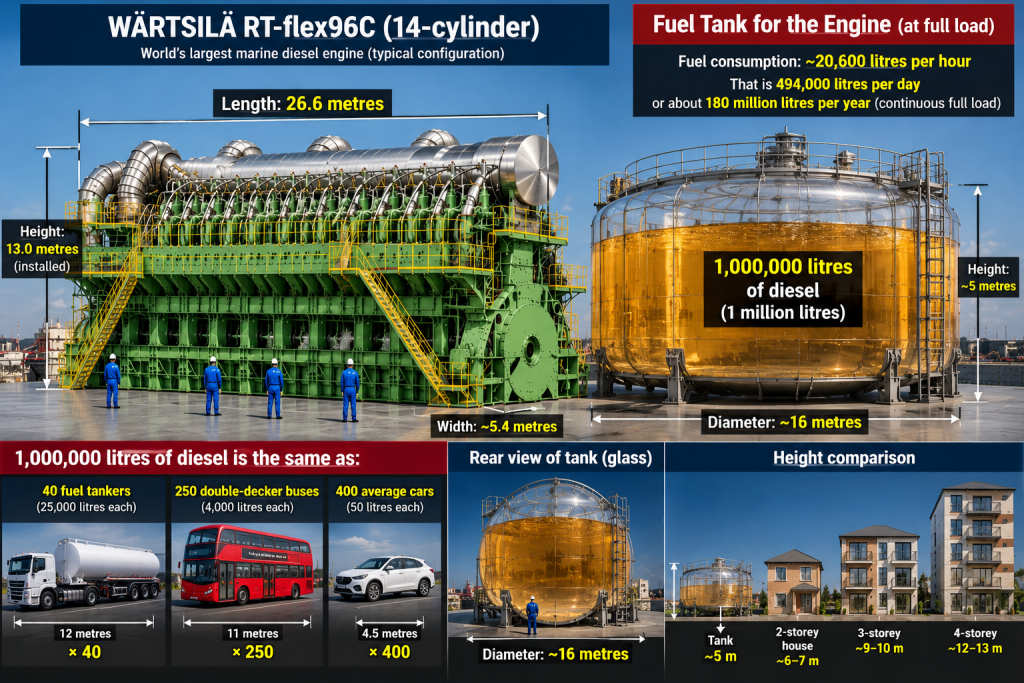
At that enormous output, fuel consumption is measured in many tonnes per hour, and an enormous flow of air must pass through the engine to support combustion.
That leads to the question at the centre of this investigation:
How much air does this giant engine require, and how does that compare with the moving air that an ancient sailing ship needed across its sails?
Part 4 — How Much Air Does This Giant Engine Need?
Now we can put a number on something we normally cannot see: the enormous amount of air flowing through this engine.
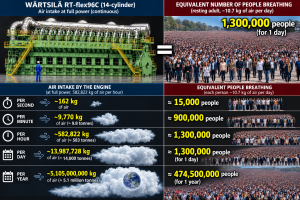
At maximum continuous output, the 14-cylinder Wärtsilä RT-flex96C has a reported scavenge-air mass flow of approximately:
582,822 kg of air every hour
That is about:
162 kg every second
9,714 kg every minute
582.8 tonnes every hour
13,988 tonnes every day
And if the engine theoretically operated continuously at this output for an entire year:
About 5.1 MILLION TONNES OF AIR would pass through the engine.
This does not mean the engine “burns” all this air. Fuel burns. The engine draws in this enormous quantity of air because combustion requires the oxygen contained in the air.
And remember where we started:
Wind is moving air.
The ancient sailing ship used moving air directly against its sails.
The modern ship replaced the sails with an engine—but that enormous engine itself requires a continuous supply of atmospheric air.
So now comes the fascinating comparison:
Which requires interaction with more air—the giant modern engine or the sails of an ancient ship?
We will calculate that next.
Part 5 — How Much Moving Air Did a Sailing Ship Need?
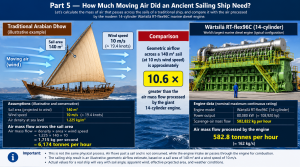
Now we can compare the modern engine with a traditional sailing vessel.
To keep the calculation understandable, let us use a 140 m² sail as an illustrative example. A published account of Arabian dhows describes a mainsail of approximately 140 m², while also noting that very large dhows could carry substantially more sail area. AramcoWorld
Let us assume wind moving at 10 metres per second, approximately 19.4 knots, and standard sea-level air density of about 1.225 kg/m³.
The basic calculation is:
Air mass flow = air density × sail area × wind speed
So:
1.225 × 140 × 10 = 1,715 kg of air per second
That equals approximately:
6,174 TONNES OF MOVING AIR PER HOUR
Now compare that with our giant modern marine engine:
Traditional 140 m² sail example: ≈ 6,174 tonnes/hour
RT-flex96C engine: ≈ 582.8 tonnes/hour
On this particular set of assumptions, the mass of air geometrically flowing through an area equal to the sail is approximately:
10.6 TIMES GREATER than the engine’s air mass flow.
That result might seem surprising, but we must understand what we’re comparing.
The sailing ship does not consume 6,174 tonnes of air every hour. The wind flows past and around the sail, transferring some of its momentum to the vessel.
The diesel engine works differently. Air actually passes through the engine; oxygen from that air supports combustion, and the exhaust gases leave the engine.
So this is not a claim that the two machines use air in exactly the same way. It is a comparison of the mass flow of air involved in two very different propulsion systems.
The physics of sailing confirms that aerodynamic force depends on factors including air density, wind speed, sail area, sail shape and angle to the wind. Diva Portal
And this brings us back to an important point:
Replacing the sails did not make air disappear from the story.
The ancient ship obtained propulsion from moving atmospheric air directly.
The modern diesel ship obtains its mechanical power from fuel combustion that requires oxygen from atmospheric air.
The technology changed enormously.
The dependence on the physical laws governing the natural world did not.
And this is precisely why saying, “We have an engine now, therefore we no longer need the wind,” does not end the discussion. The modern ship may no longer require wind against a sail, but the engine itself has not escaped nature. It operates through air, oxygen, fuel, pressure, heat, water, mechanical force and the laws of physics.
The sails disappeared. The laws of creation did not.
Part 6 — The Engine Did Not Defeat Nature — It Uses Nature Differently
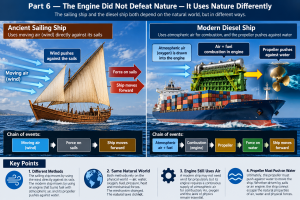
We can now see why the statement “modern ships do not need the wind because they have engines” needs to be examined more carefully.
In one sense, it is correct.
A modern diesel-powered ship does not need wind pushing against sails in order to move. Its propeller can drive the ship even when the natural wind is calm.
But that does not mean the ship has become independent of the natural world.
The sailing ship and the diesel ship simply obtain propulsion in different ways.
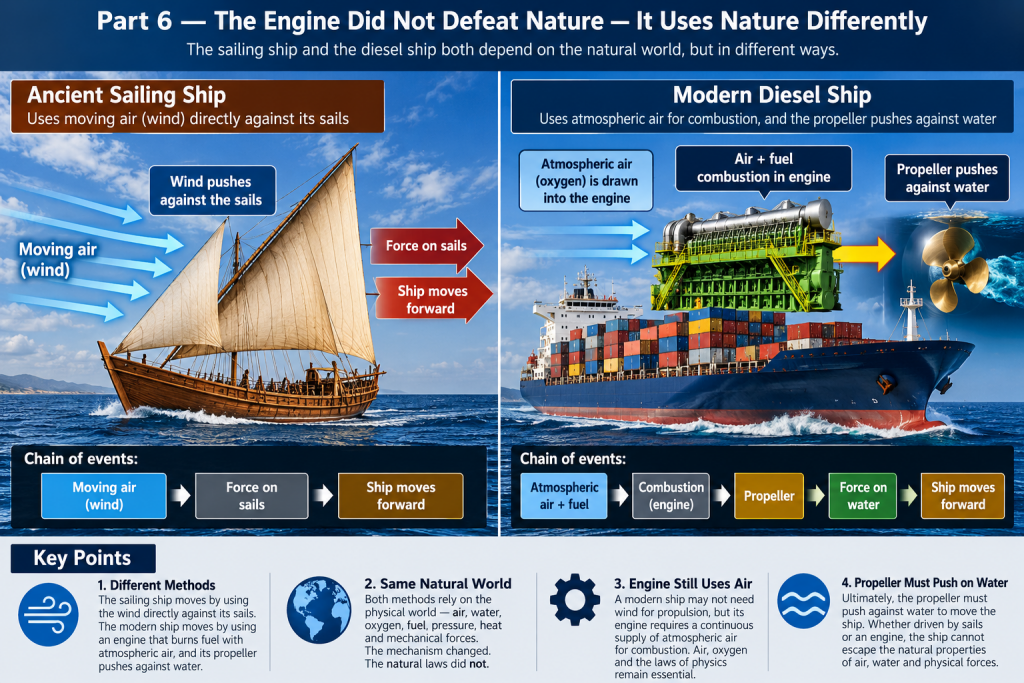
The sailing ship:
Moving air → force on sails → ship moves.
The modern diesel ship:
Atmospheric air + fuel → combustion → engine → propeller → force on water → ship moves.
The mechanism changed.
The physical world did not.
What Happens If the Wind Stops?
This distinction is especially important when we return to the words of the Qur’an:
“If He wills, He can still the wind, leaving them motionless on its surface.”
The Arabic word الرِّيح (ar-rīḥ) means the wind.
Wind is moving air.
If the wind becomes still, the atmosphere does not disappear. The air is still there. Oxygen is still there. What disappears is the movement of the air that the sailing vessel depended upon for propulsion.
That distinction matters.
A sailing vessel can become motionless when the wind disappears because its source of propulsion has disappeared.
A diesel ship can continue moving because it does not obtain its propulsion directly from the wind.
But its engine still requires air.
So Did the Engine Make the Verse Obsolete?
No.
The verse describes ships whose movement can depend upon wind, and the physical principle behind that statement remains completely understandable today.
Modern engineering discovered another method of propulsion. It did not prove that wind never mattered, nor did it make air, oxygen, water or the laws of physics unnecessary.
In fact, the giant engine we examined demonstrates something interesting.
To escape direct dependence on wind against sails, humans built an extraordinary machine weighing thousands of tonnes and producing more than 80 megawatts of power.
That machine requires fuel.
It requires atmospheric oxygen for combustion.
It requires cooling.
It requires lubrication.
It requires enormous mechanical forces to be controlled.
And ultimately, its propeller must push against water to propel the ship forward.
Human engineering did not abolish the laws governing the sea.
Technology Changes the Method — Not the Laws
This is one of the most important distinctions in this discussion.
When humans invent an engine, an aircraft, a turbine or a rocket, we do not create new laws of nature.
We learn how to work within laws that already exist.
Engineers calculate pressure.
They calculate temperature.
They calculate density.
They calculate combustion.
They calculate forces.
They calculate the behaviour of air and water.
If those physical relationships did not behave consistently, engineering itself would become impossible.
So replacing a sail with an engine should not be described as humanity defeating nature.
It is humanity learning another way to use the properties of nature.
And That Brings Us Back to the Original Claim
The argument began with something that sounded simple:
“We don’t need the wind anymore. We have engines.”
But after looking more closely, the reality is far more interesting.
Yes, modern ships can travel without relying on natural wind for propulsion.
But they did not achieve this by becoming independent of creation.
They achieved it by constructing machines that operate through air, oxygen, fuel, heat, pressure, metal, water and physical laws.
The sail disappeared.
The dependence on wind for direct propulsion disappeared.
But dependence on the physical order of the natural world did not.
And perhaps that is where the discussion becomes much deeper than simply asking:
“Does the ship have sails, or does it have an engine?”





















































Responses