Brain Health: It’s Not Just About What You Eat

🧠 Brain Health: It’s Not Just About What You Eat
When people talk about brain health, they often focus on foods such as almonds, pumpkin seeds, fish or dark chocolate. These foods can certainly be part of a healthy diet, but a healthy brain needs much more than food.
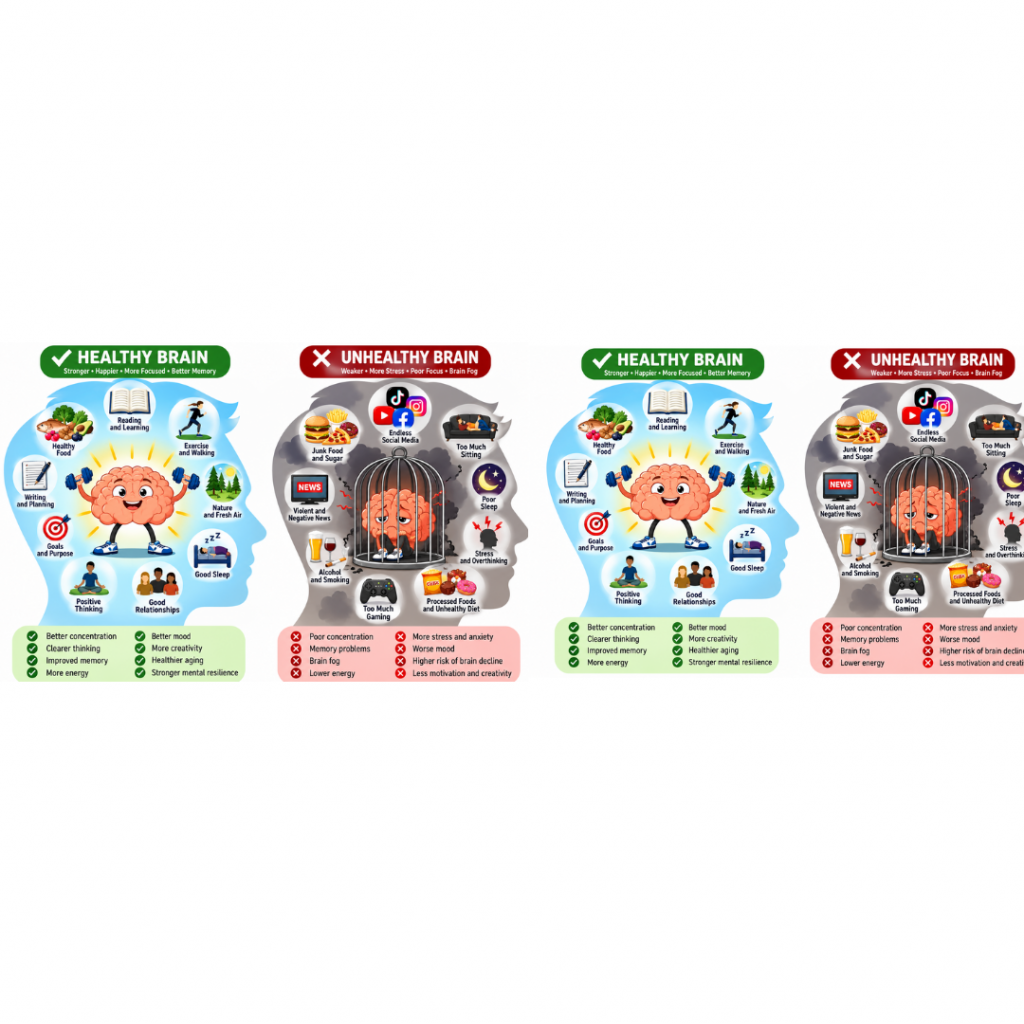
Your brain needs good nutrition, physical activity, quality sleep, learning, meaningful relationships, purpose and time away from constant stimulation.
Think about your brain in the same way you think about your body: feed it well, exercise it, challenge it, let it recover and be careful what you repeatedly put into it.
🥗 Foods That Support Brain Health
There is no single miracle food that makes your brain healthy. A balanced diet containing plenty of whole and minimally processed foods is a much better approach.
Good choices include:
- Fatty fish such as salmon, sardines, mackerel and trout
- Walnuts, almonds, pistachios and other unsalted nuts
- Pumpkin, sunflower, sesame and other seeds
- Extra-virgin olive oil
- Eggs
- Leafy vegetables such as spinach, kale and cabbage
- Broccoli and other vegetables
- Blueberries, strawberries, blackberries and raspberries
- Apples, oranges, grapes, pomegranates and other whole fruits
- Beans, lentils, chickpeas and peas
- Oats, barley, whole-grain bread and other whole grains
- Tomatoes, peppers, onions and garlic
- Avocado
- Plain yogurt and kefir
- Small amounts of high-cocoa dark chocolate
- Plenty of water
You don’t need to eat everything on this list every day. Variety and your overall eating pattern matter more than one particular food.
🍟 What Should You Limit?
Again, one burger or piece of cake isn’t going to ruin your brain. The concern is what becomes your normal everyday diet.
Try to limit:
- Ultra-processed foods
- Fast food
- Deep-fried foods
- Sugary drinks
- Excessive sweets, cakes and biscuits
- Large amounts of refined carbohydrates
- Processed meats
- Excessive saturated fat
- Too much salt
- Excessive alcohol
Smoking is also harmful to your overall health, including the blood vessels that supply your brain.
📚 Don’t Just Feed Your Brain — Exercise It
This is the part that is often forgotten.
You can eat almonds, fish and vegetables every day, but your brain still needs to be used and challenged.
Read
Read books, history, science, biographies, business, religion, technology and subjects you know nothing about.
Don’t only read things you already understand. Challenge yourself.
Write
Write down your ideas.
Keep notes. Write articles. Plan your day. Summarise what you’ve learned. Try explaining difficult ideas in your own words.
Writing forces your brain to organise information rather than simply consume it.
Study
Never decide that you’re too old to learn.
Learn a language. Study history. Learn technology. Learn gardening, mechanics, mathematics, programming, business or another useful skill.
Keep being a student throughout your life.
Teach What You Know
One of the best tests of understanding something is trying to explain it clearly to somebody else.
Learn something → understand it → practise it → teach it.
Teaching can expose the gaps in your own knowledge and make you think more deeply about what you’ve learned.
Ask Questions
Don’t automatically believe everything you hear.
Ask:
Why?
How?
Where is the evidence?
What is the other side of the argument?
Could I be wrong?
Can I investigate this myself?
Critical thinking is another form of mental exercise.
🚶 Move Your Body
Your brain isn’t separate from the rest of your body.
Walk regularly. Exercise. Strength train if appropriate for you. Cycle. Swim. Garden. Work outside.
And sometimes simply walk through nature.
Put your phone away for a while. Look at the trees. Listen to the birds. Think. Reflect. Let your mind slow down.
Physical activity supports cardiovascular health, and healthy blood vessels are extremely important for the brain.
😴 Protect Your Sleep
Don’t treat sleep as wasted time.
Sleep is important for attention, memory, learning, mood and many other functions.
Try to maintain a reasonably consistent sleep schedule and give yourself enough time to sleep.
Scrolling through your phone in bed until 2 a.m. and then expecting your brain to perform perfectly the next morning isn’t a good strategy.
❤️ Spend Time With Good People
Human beings need other human beings.
Talk with family and friends. Have meaningful conversations. Laugh. Help somebody. Listen to other people’s experiences.
Try to spend more time around people who encourage learning, responsibility, good character and progress.
And remember that social interaction itself challenges the brain: you listen, remember, interpret, respond and communicate.
🎯 Have Goals and Purpose
Give your brain something meaningful to work toward.
It doesn’t have to be becoming a millionaire.
It might be:
Learning English.
Writing a book.
Building a business.
Growing a garden.
Learning the Qur’an.
Helping your family.
Getting fitter.
Learning a trade.
Teaching your children.
Creating something useful.
Wake up knowing that there is something worth doing today.
📱 Be Careful With TikTok, Facebook, Instagram and YouTube Shorts
Social media isn’t automatically bad. These platforms can teach you incredible things.
You can learn a language on YouTube. You can discover history on TikTok. You can follow educational pages on Facebook or Instagram.
The problem is endless, automatic short-form scrolling.
One video makes you laugh.
Swipe.
Someone is fighting.
Swipe.
A beautiful car.
Swipe.
A tragedy.
Swipe.
Someone dancing.
Swipe.
A political argument.
Swipe.
A motivational quote.
Swipe.
Another tragedy.
Your attention is constantly being pulled toward something new.
After spending hours consuming something different every few seconds, don’t be surprised when sitting down with a book for 30 minutes feels difficult.
So don’t allow an algorithm to control every spare moment of your attention.
Use technology deliberately instead of letting technology use your attention.
Read longer material. Watch full educational programmes. Finish a chapter. Learn something deeply. Put your phone down while working. Spend periods of the day without constant notifications.
📺 Be Careful What You Feed Your Mind
There is another kind of diet that has nothing to do with food:
Your information diet.
Imagine waking up every morning and immediately hearing:
Someone was murdered.
Someone was robbed.
A woman was raped.
A child was abused.
There’s another war.
There’s another disaster.
Another political fight.
Another murder.
Another tragedy.
Then you spend another hour scrolling through arguments, fear, anger and disturbing videos.
And afterward you expect yourself to have a positive, focused and dynamic day.
That doesn’t mean we should ignore reality.
We should know what is happening around us. Important events matter.
But there is a difference between being informed and repeatedly consuming frightening or negative material for hours.
You don’t need to watch the same tragedy discussed by ten different programmes.
Know what happened. Understand what matters. Then continue living your life.
🌱 Positive Thinking Doesn’t Mean Ignoring Problems
Positive thinking shouldn’t mean pretending that everything is wonderful.
Life contains illness, death, failure, financial difficulties, conflict and disappointment.
Healthy positive thinking is closer to saying:
“This problem exists. What can I do about it?”
Instead of:
“Everything is terrible. Nothing will ever change.”
Accept reality, learn from mistakes, look for solutions and keep moving forward.
🧘 Give Your Brain Some Quiet
You don’t need entertainment every second you’re awake.
Sometimes:
No television.
No TikTok.
No YouTube.
No music.
No notifications.
No scrolling.
Just sit, walk, pray, reflect or think.
Boredom isn’t necessarily an emergency that needs to be fixed with a phone.
Your brain deserves moments when nobody is trying to sell you something, frighten you, entertain you or capture your attention.
🧠 The Bigger Message
So when somebody asks:
“What is the best food for my brain?”
Perhaps the better question is:
“What am I feeding my brain every day?”
Not only through your mouth.
What are you reading?
What are you watching?
What are you listening to?
What are you learning?
Who are you spending time with?
How much are you moving?
How are you sleeping?
What are you creating?
What are you thinking about repeatedly?
Feed your body well.
Read.
Write.
Study.
Learn.
Teach what you know.
Exercise.
Walk in nature.
Sleep properly.
Spend time with good people.
Have goals.
Create more and consume less.
Control your social-media use.
Stay informed without drowning yourself in negativity.
And never stop learning.
A healthy brain isn’t built by one magical food. It is supported by an entire way of living.